
The MDPI journal Insects is publishing a Special Topics series on insect rearing science with a special focus and emphasis on papers that at once contribute to the basic science behind rearing while making practical contributions to rearing technology. Please note the announcement of the Special Issue and the explanation here:
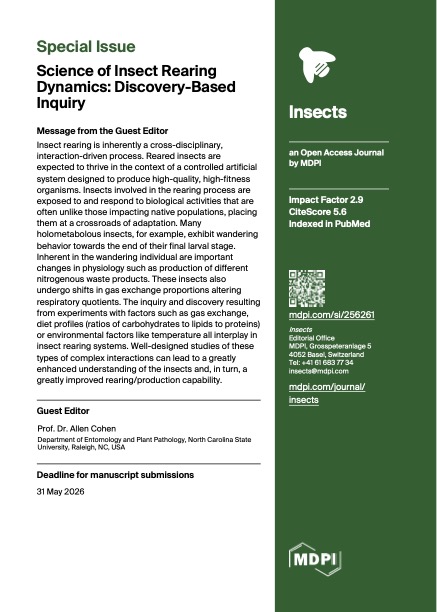

Please note that we will be extending the deadline for six months. If this type of research is of interest to you, please consider doing a research or review paper that fulfills the mission of showing and telling WHAT rearing technology will help improve insect rearing as to what kinds of rearing systems components and processes are of value leading to production of insects that are highly fit and/or of high quality. And also, the intended papers will explain the WHY and HOW of the rearing system inquiries work. In other words, we are seeking scientific inquiry that taps deeply into basic science while it shows the applications of that science. A crucial part of the welcome papers is that they are based on .explicitly-stated rationale. Here are some examples to suggest the kind of dual function papers, we are seeking for the Special Issue.
I have presented here 1) a background paper the provides basic science and then 2) a possible rearing improvement paper that connects the basic discovery to a practical rearing application.
Potential examples
- Omega 3 unsaturated fatty acids effects on learning and brood rearing in beesimprovement of various fitness parameters in reared insects (weight, development rate, fecundity, etc. (see reference 1)
- Improving containers to increase gas exchange efficiency Increase in various biological fitness measures (growth rate, fecundity, survival, antimicrobial defenses, etc. (see reference 2)
- Hypoxia affects growth rate ample supply of O2 and improvement of growth and development rate (and other biological parameters such as fecundity and survival) (see reference 3)
- Carotenoids and vision improvements in fitness resulting from addition of key carotenoids and related pigments (see reference 4)
- Dietary protein quality and immune functionability of reared insects to withstand exposure to microbial growth in rearing system. (see reference 5)
- Wolbachia (bacteria) affect reproductive performance in Wolbachia-compatible vs. incompatible strainsDetection and then manipulation of Wolbachia in colonies. (see reference 6).
References:
- Fabian A. Ruedenauer, Alexa Aline Schaeffler, Tim Schneider, Gabriela Rakonic, Johannes Spaethe, Sara D. Leonhardt. Does fat identity matter? The effect of saturated and unsaturated fatty acids on bumble bee consumption and fitness. Ecological Entomology. 50: 318-328. 2025.
- VandenBrooks, J.M. et al. Supply and demand: how does variation in atmospheric oxygen during development affect insect tracheal and mitochondrial networks. J. Insect Physiol.
- Acute and chronic effects of atmospheric oxygen on the feeding behavior of Drosophila melanogaster larvae. Manoush Farzin, Todd Albert, Nicholas Pierce, John M. VandenBrooks 1, Tahnee Dodge, Jon F. Harrison. J. Insect Physiol. 68 (2014)
- Reinecke, J. P. 1991. Increased field trap capture of the mass-reared boll weevil (Coleoptera: Curculionidae) fed diet supplemented with beta-carotene. J. Econ. Entomol. 84 (2): 633-637
- K. P. Lee, S. J. Simpson and K. Wilson. Dietary protein-quality influences melanization and immune function in an insect. Functional Ecology 22. 2008.
- Steen Christensen, Moises Camacho, Zinat Sharmin, A. J. M. Zehadee Momtaz, Laura Perez,Giselle Navarro, Jairo Triana, Hani Samarah, Michael Turelli, and Laura R. Serbus Quantitative methods for assessing local and bodywide contributions to Wolbachia titer in maternal germline cells of Drosophila. MC Microbiology https://doi.org/10.1186/s12866-019-1579-3