
First, let’s find a definition and characterization of “oracle.” A Google AI search gave us this characterization: “An oracle is a person, shrine, or medium believed to provide wise, prophetic counsel or divine revelations, often associated with ancient Greek figures like the Oracle at Delphi. It also refers to an expert who is an unquestioned authority on a subject.” Well we aren’t looking for shrines, but the rest of the definition applies to what many rearing professionals or staffs seek in getting help on either developing or improving rearing systems.
People in the insect rearing community often need and seek a person or medium that can give them answers to questions such as how do I rear a given insect? How do I solve a problem in my existing rearing program? I am suggesting in this blog entry and the one I posted yesterday that NEURAL NETWORKING (NN) can be a kind of oracle or source of rearing wisdom. It is an AI tool that helps us manage huge amounts of information about rearing systems. It is especially helpful as a way of looking into our own rearing system–especially if we have been diligently building baseline information about our rearing system.
For the current discussion on NN applications, I am exploring the question: “How can I rear painted lady butterflies (Vanessa cardui) on an artificial diet?” I am exploring this question from three possible vantage points or 3 tiers.
Tier 1: Google response to “rearing painted lady butterflies on artificial diet”:
Rearing Painted Lady butterflies on artificial diet is a straightforward process, often done using pre-mixed “cookie dough” or agar-based diets available from educational suppliers like Insect Lore or Carolina Biological. Larvae are kept in cups at room temperature, feeding for 10–14 days before pupating on the lid. Google’s AI synthesis gives us a few useful pieces of information, for example that we can get the diets and the insects from Insect Lore or Carolina Biological (two of several suppliers of these insects and pre-made diets).
Tier 2: The initial summary by Google’s AI tool does not give many rearing details, however, but a further search–if you happen to know that Chen Zha and Allen C. Cohen published a study of Helicoverpa zea and Vanessa cardui in the following:
Research Article – (2014) Volume 3, Issue 1
Effects of Anti-Fungal Compounds on Feeding Behavior and Nutritional Ecology of Tobacco Budworm and Painted Lady Butterfly Larvae: Entomology, Ornithology & Herpetology:
Chen Zha and Allen C. Cohen*Program Coordinator & Research Professor, Insect Rearing Education & Research Program, North Carolina State University, USA*Corresponding Author:Allen C. Cohen, Program Coordinator & Research Professor, Insect Rearing Education & Research Program, North Carolina State University, USA, Tel: 919-513-0576 Email: accohen@ncsu.edu
Zha and Cohen, Entomol Ornithol Herpetol 2014, 3:1DOI: 10.4172/2161-0983.1000120. If you went to the open-access article by Zha and Cohen, you would find granular details about the way the diet is made and other key rearing factors for painted lady butterflies and corn earworms. OR, if you searched a high caliber search system such as Web of Science, using the key words, “painted lady| rearing| artificial diet,” you would find a few papers listed where rearing painted lady butterflies is mentioned, but none of these articles provided details on the diets you would use, only that proprietary diets were purchased from suppliers. So this chase leads us back to our laboratory where we are trying to develop or improve a diet for painted lady butterflies. So far, neither open AI searches nor conventional literature searches have given us much help. Part of this problem is one that I have complained about for years–that even when rearing information does exist somewhere in the literature or the scientific world, it’s too often hidden from easy access. But this is another problem to be discussed in a future blog post. For now, I want to get into Tier 3 using neural networking to help us find ways to improve or establish a diet for a target insect.
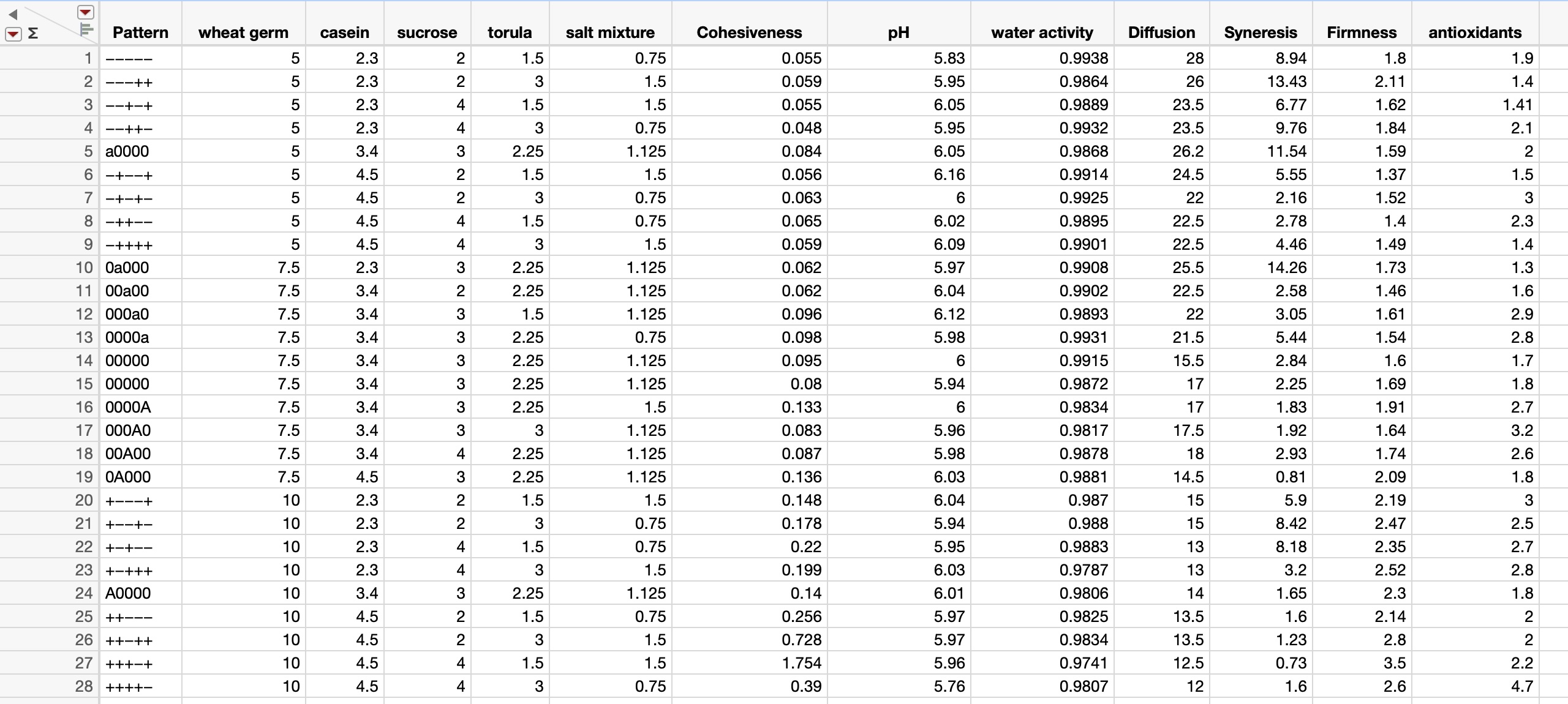
Tier 3: For using neural network analysis and predictions, let’s use an example of an experiment done in my lab recently. I used DoE to set up an experimental protocol to determine which of the 5 major components of the Yamamoto 1969 diet for tobacco hornworms. Here is the dataset:
Next, see the diagram for the neural network with its inputs, outputs, and nodes where calculations take place.
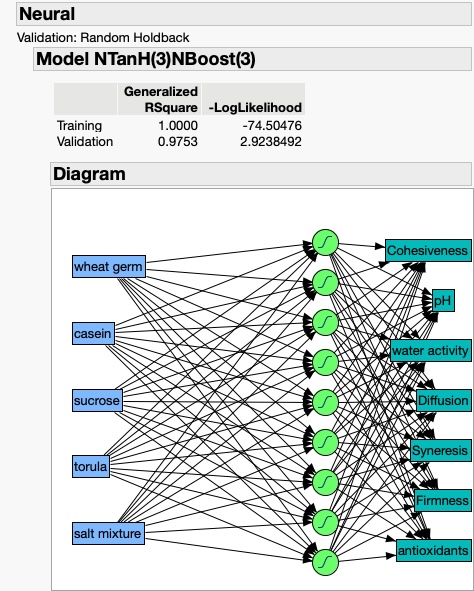
Figure 2. Shows the inputs from Yamamoto Diet prepared with different concentrations of wheat germ, casein, sucrose, torula, and salt mixture and further showing the outputs cohesiveness, pH, etc. The prediction profiler shows the initial response of the neural network analysis.
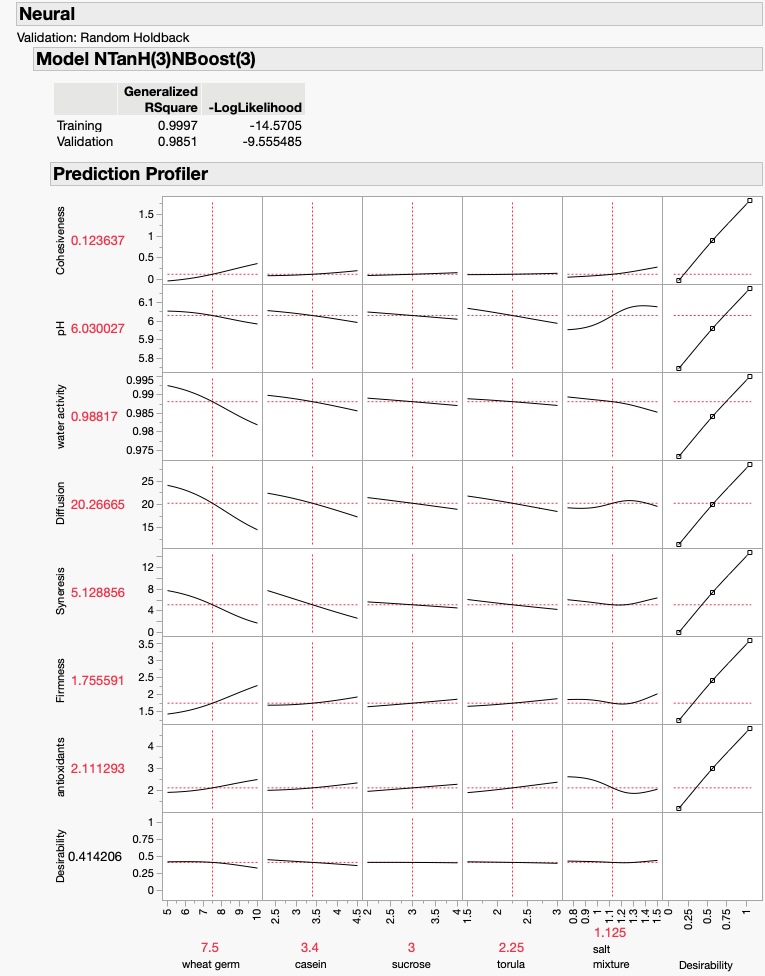
Figure 3. The output of the JMP neural network analysis showing the effects of all factors that are diet components and that were varied in this set of experiments. Note how, for wheat germ for example, the increase in wheat germ decreases the syneresis (which is the “leakage” of water from the gelled diet). At the same time, increasing wheat germ increased the firmness and cohesiveness of the diet–both qualities being desirable for most insects.
We will explore this AI-neural network-based approach in the next blog entry.
Happy rearing!